Market Entry
Backup Power for a Factory in Sri Lanka: Rent, Buy or Use Energy Storage?
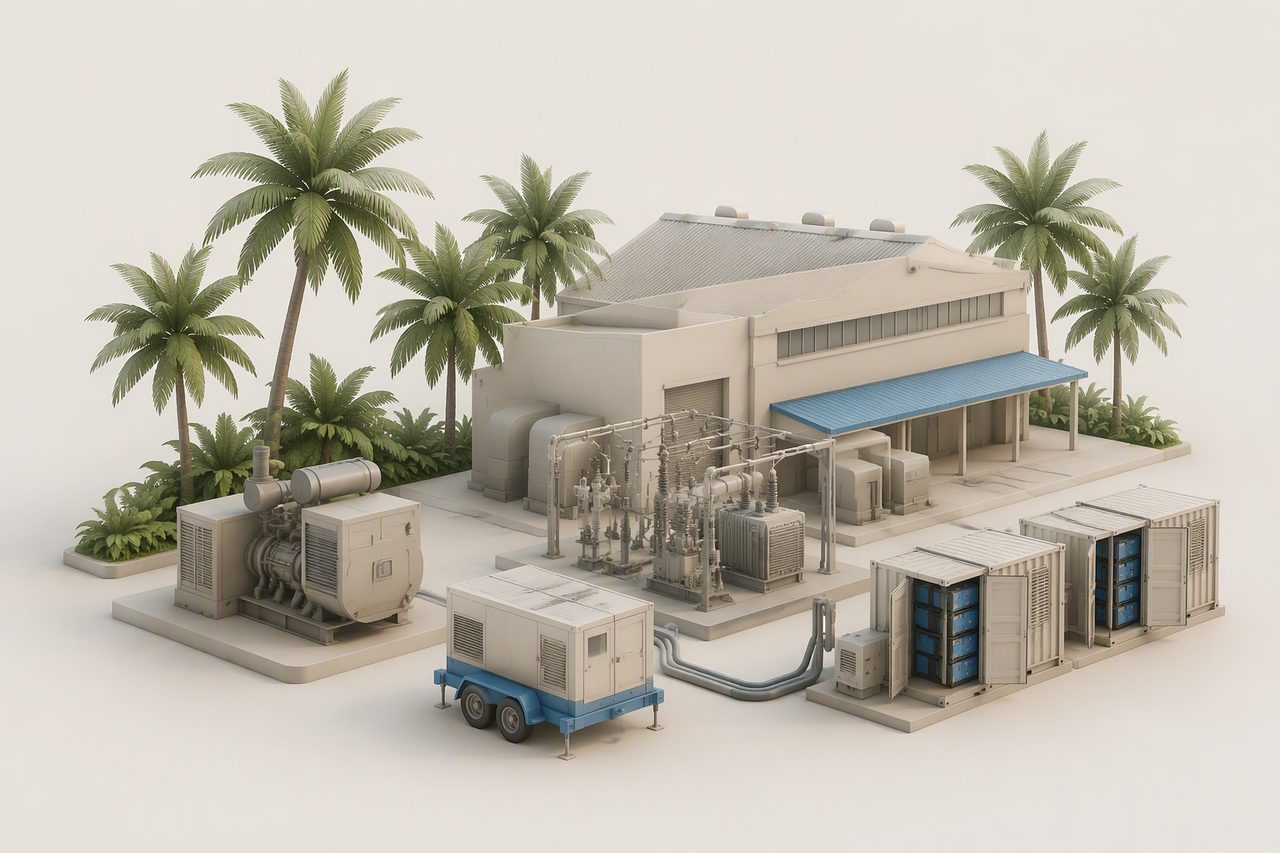
For a factory in Sri Lanka, there is no universal answer to whether backup power should be rented, purchased or supported by energy storage. Start with available site capacity, outage scenarios, critical loads and lease responsibilities. Then compare upfront and ongoing costs: rental may suit shorter or uncertain projects; purchase may suit stable long-term use; storage may suit frequent short outages and sensitive equipment. Many projects use a combination.
You may be preparing to sign a factory or warehouse lease while finalising an equipment list. The landlord says the premises have “three-phase power” or “backup power”, but cannot confirm the load it can sustain, which areas remain powered during an outage, or who maintains the equipment. Choosing a generator model too early can put both budget and responsibility in the wrong place. Backup power is a site-selection, engineering, lease and operations issue—not simply the purchase of one machine.
What should be included in your critical-load list?
What you need to do: divide expected electricity demand at the site into three groups: loads that cannot lose power, loads that can stop briefly, and loads that can be restored later. Production lines, cold-chain systems, warehouse systems, servers, security equipment, lighting, office equipment and charging equipment should not all sit in one general power schedule.
Who is responsible: your project lead should provide equipment and operating plans. Equipment suppliers or suitably qualified electrical professionals should help verify starting loads, continuous loads and switching requirements. MMD Business Support can assist with document organisation, site communication and connections to local professional resources, but does not replace electrical design, engineering sign-off or approvals from competent authorities.
A common issue: many teams simply add up equipment nameplate ratings. They overlook large equipment start-up demand, equipment operating simultaneously across different shifts, and future load changes following expansion. The backup system may appear sufficient on paper, but critical equipment may then exceed available capacity at start-up or require manual load restrictions.
Do you need to separate critical loads from total loads?
Yes. The purpose of backup power is not usually to keep the entire factory operating at full load under every circumstance. It is to maintain safety during an interruption, reduce inventory or equipment loss, and restore operations in order of priority. Your critical-load list should be confirmed jointly by operations, equipment, IT, security and site-management teams, rather than being decided by procurement alone.
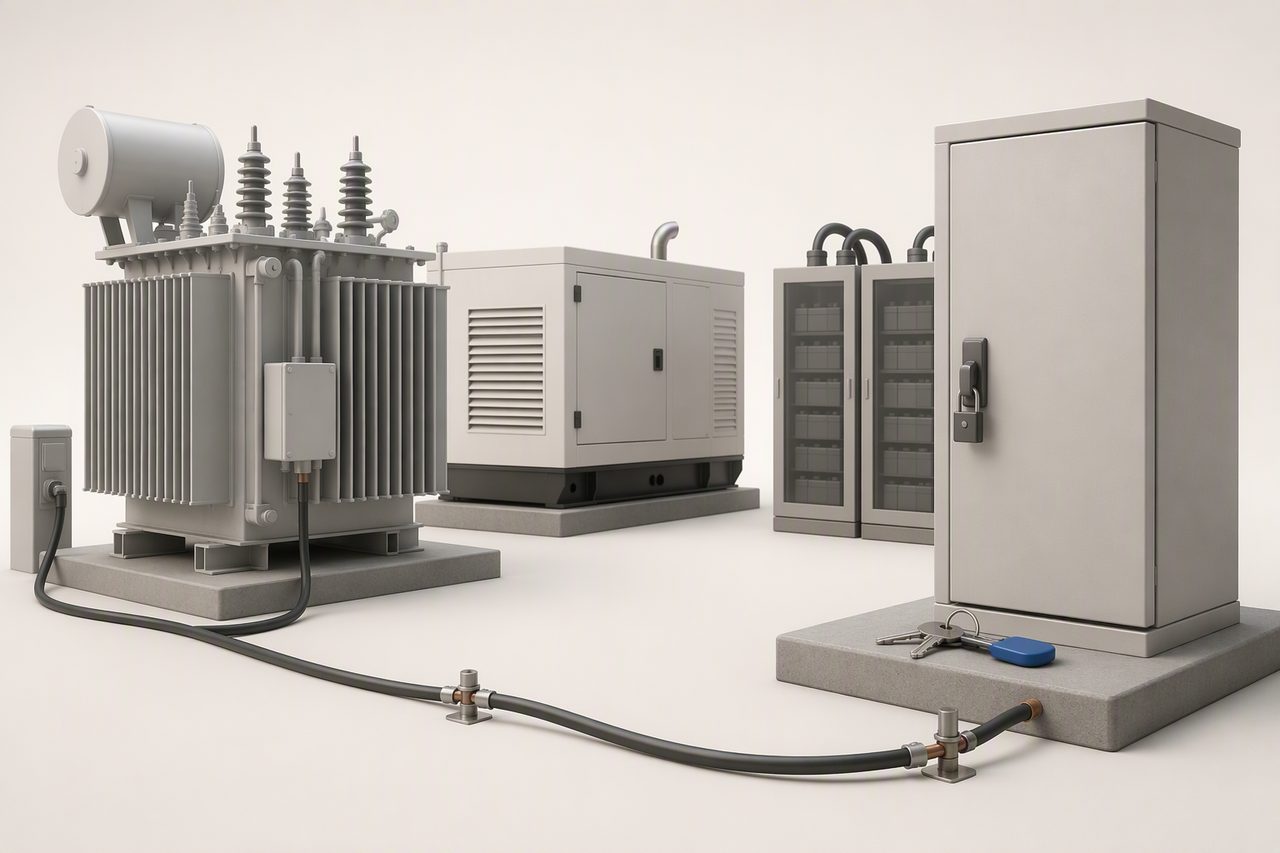
What site power conditions and landlord responsibilities should you verify?
What you need to do: before signing the lease, paying fit-out costs or ordering equipment, ask to review existing electrical distribution information, usable capacity, switchboard condition, backup-equipment information, maintenance records and site connection conditions. You also need to confirm whether there is suitable space for generators, energy-storage equipment, fuel areas and cable routes.
Who is responsible: the landlord or property manager should explain existing facilities and the boundary of its responsibilities. Your engineering adviser should assess whether connection is suitable on site. The party reviewing the lease should clearly document responsibility for maintenance, fault handling, fuel, modifications, removal and ownership of equipment.
A common issue: a landlord’s statement that a site has “backup power” does not mean that the system can support your production load. It also does not mean the landlord will cover fuel, repairs or losses caused by a failure. Many occupiers assume that leasing a factory with a generator removes the need for a separate backup-power budget. In practice, equipment capacity, availability, maintenance responsibility and priority supply areas may all be limited. The cost of this misunderstanding is often discovered only after operations begin, when critical areas are found not to be connected to the backup circuit.
If your project proceeds through an investment-project route, project-entry and related requirements should be checked against the latest information published by the Board of Investment of Sri Lanka. Site power, engineering modifications and operating requirements should also be confirmed for the specific project by local professional advisers you appoint.
How do you screen rental, purchase and energy-storage options?
What you need to do: make an initial assessment based on project duration, outage length, load characteristics and operational tolerance. Do not begin by comparing the price of a single piece of equipment.
Who is responsible: the project lead should define the commissioning plan and budget period. The operations team should explain the consequences of downtime. Electrical professionals should advise on technical feasibility. Suppliers can submit proposals against one consistent load schedule.
A common issue: suppliers may quote based on different assumptions. One quotation may cover only the equipment itself, while another may include transport, installation, switching equipment, fuel arrangements or maintenance. Without a common scope, quoted amounts are not comparable.
| Option | Situations commonly worth assessing first | Key points to confirm |
|---|---|---|
| Rental of backup generation equipment | Limited project duration, output not yet stable, or a preference to reduce upfront capital committed to equipment | Minimum rental term, transport and installation, fuel arrangements, maintenance response, replacement equipment following failure, return conditions and site-reinstatement responsibility |
| Purchase of backup generation equipment | A longer expected site occupancy period, relatively stable load and capacity to include the equipment in long-term operations management | Procurement scope, installation conditions, warranty and maintenance, spare parts, fuel storage, and future relocation or transfer arrangements |
| Energy-storage system | Frequent but short interruptions, equipment sensitive to switching, or a need to cover selected high-priority loads | Actual supported load and duration, charging conditions, compatibility with existing systems, maintenance and safety management |
| Combined solution | A need to manage both short switching events and longer outages | Which loads are covered by storage, which by generating equipment, and who is responsible for testing and maintaining switching logic |
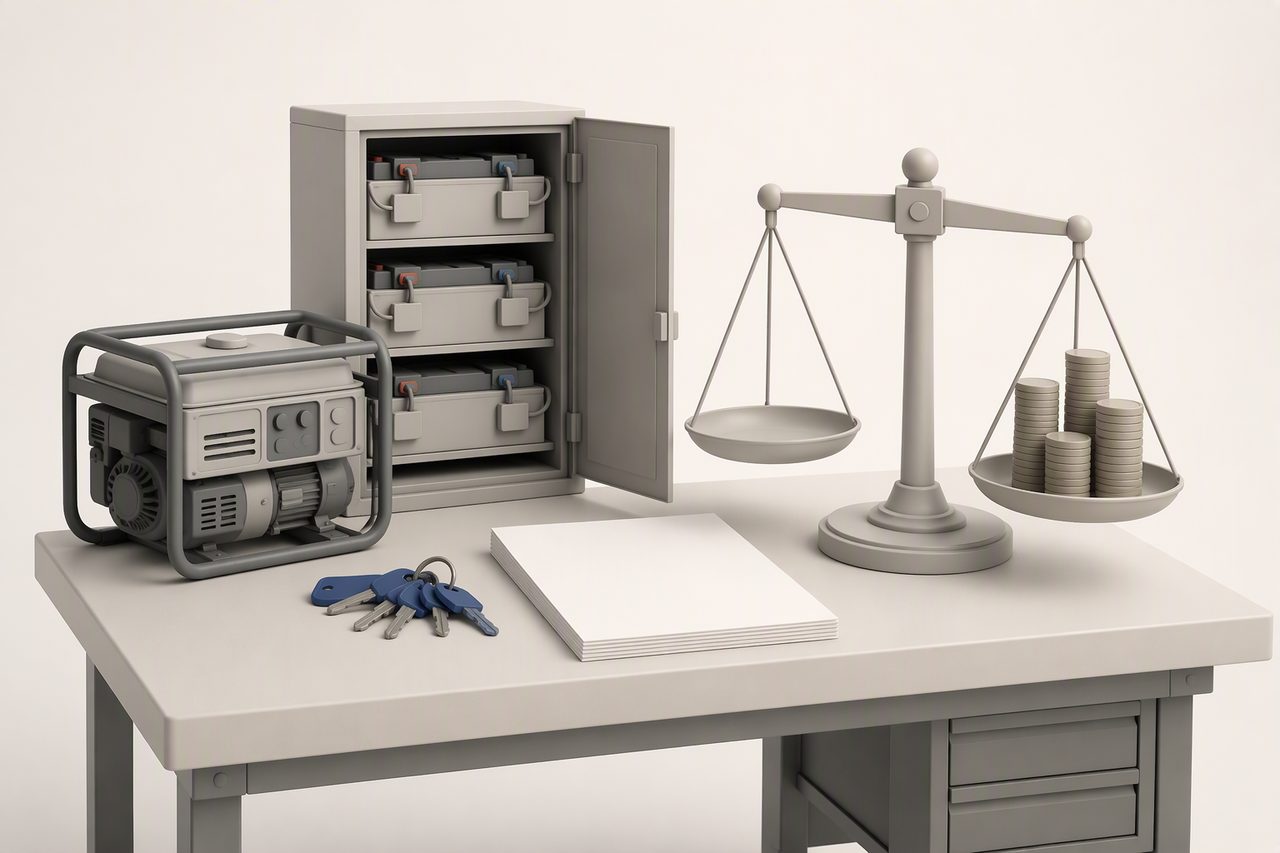
How should you compare quotations, and where will the money be spent?
What you need to do: send each supplier the same requirement brief. Ask them to separate one-off costs, recurring costs, site conditions and exclusions. Do not ask only for a single total price.
Who is responsible: procurement or finance should build the comparison table. Your engineering adviser should verify the technical scope. The landlord or property manager should confirm site connections and construction restrictions. Contract reviewers should address default, damage and allocation of responsibility.
A common issue: a generator rental may have a relatively modest monthly charge, while fuel, transport, installation, cables, maintenance, standby services and charges for use outside the agreed scope may not be included. For a purchase, the equipment price is only the starting point. Further costs may include civil works, connection modifications, testing, maintenance, spare parts and staff management. For energy storage, check whether the proposal includes the necessary control equipment, installation, monitoring and follow-up service.
At a minimum, ask quotations to state:
- the scope of the equipment itself or the rental service;
- whether transport, lifting, installation, commissioning and removal are included;
- who is responsible for fuel, operating personnel, routine maintenance and emergency repairs;
- whether site distribution modifications, switching equipment, cables and civil works are charged separately;
- the load, operating hours and use scenarios assumed in the quotation;
- fault-response arrangements, replacement-equipment arrangements and limits of responsibility; and
- equipment ownership, removal and site-reinstatement responsibilities at the end of the contract.
How do you make backup power operational before commissioning?
What you need to do: include backup power in site handover and operational testing before formal commissioning. Do not wait for the first interruption to find out whether it works. Testing should cover whether critical loads switch as expected, whether staff understand operating procedures, whether fuel and maintenance arrangements can be carried out, and who coordinates when a fault occurs.
Who is responsible: the site manager should retain equipment records and maintenance documentation. Suppliers should provide services in accordance with their contracts. The landlord is responsible for facilities within its committed scope. Your operations team should define internal procedures for start-up, shutdown and escalation.
A common issue: installed equipment does not automatically mean backup capability is in place. Untested switching logic, critical loads that are not connected, or night-shift staff who do not know how to operate the system can all cause a paper solution to fail during an actual outage.
What is the most common mistake when comparing rental and purchase costs?
The most common mistake is to compare a monthly rental fee directly with an equipment purchase price. Rental looks like an ongoing expense, while purchase appears to be a one-time investment, but the scope and risk carried under each option can be very different. The comparison should not be “monthly fee versus equipment price”. Over your expected period of use, compare who bears the risk of equipment availability, maintenance, fuel, replacement following failure, relocation and residual value.
Use one total-cost-of-ownership table and assess each option against these questions:
- How long do you expect to occupy the site, and is lease renewal or relocation uncertain?
- Which loads must the equipment support, and will expansion require reconfiguration?
- Who bears fuel or charging costs during outages, and how will records be retained?
- If equipment fails, what is the responsibility of the supplier, landlord and your on-site team?
- If the lease ends early, equipment must be moved, or the site must be reinstated, who bears the cost?
- If equipment is purchased, can it still be used, transferred or disposed of in the future?
If these points are not included in the quotation comparison and contract schedules, the lowest quotation may not be the lowest-cost option. For high-load facilities, the outcome to avoid is straightforward: equipment is purchased but cannot be connected; equipment is rented but cannot support critical loads; or storage is installed only to discover that it covers areas unrelated to production.
This content is for general information only and does not constitute legal, tax or immigration advice. Specific requirements should be confirmed against the latest guidance from relevant Sri Lankan authorities and the licensed professional advisers you appoint.
FAQ
- Can a rented generator support normal factory production?
- It depends on critical loads, equipment start-up characteristics, site distribution conditions and the scope of the rental arrangement. Have qualified professionals verify the load schedule first, then confirm which production and safety systems the rented equipment will actually cover.
- Do I still need backup generation after installing energy storage?
- Not necessarily, but you should not assume that energy storage replaces all backup capability. The loads it can support, support duration, charging conditions and switching requirements need to be assessed against your outage scenarios and critical equipment.
- My landlord says the factory has backup power. Do I still need my own assessment?
- Yes. Confirm the backup equipment capacity, covered areas, maintenance condition, fuel responsibility, availability conditions and fault-handling arrangements. Clearly document responsibility boundaries that relate to the lease.
- When should I decide on a backup-power solution?
- Complete an initial assessment before signing the site lease and finalising the equipment layout. This allows you to review space, electrical distribution, modification responsibilities and budget together, reducing the risk of last-minute engineering work before commissioning.
Related reading



Need this applied to your case?
Tell us your team size, industry and timeline — we will map the actual path for your project.
Contact us