Office & Infrastructure
Sri Lanka Coworking vs Serviced vs Private Offices
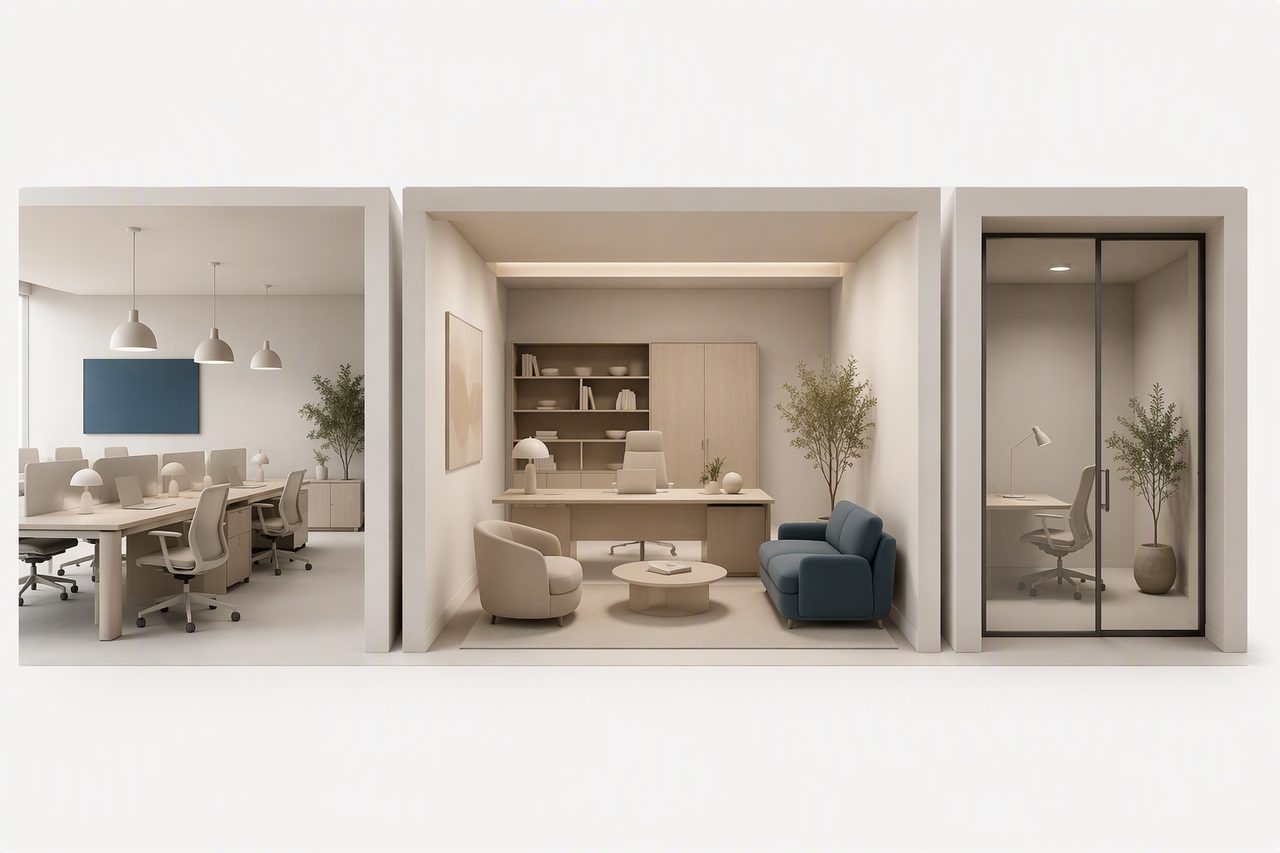
Your office choice should reflect your stage of entry, how your team works and the practical conditions of your business—not simply rent or fit-out quality. For companies entering Sri Lanka with an evolving team structure or business scope, retaining flexibility is often preferable. A more independent office can be assessed once staffing, client-facing needs and operational requirements are clearer.
Coworking spaces, serviced offices and private offices each serve different purposes. The key question is what your team will need in the near term: a business address, a few desks, a controlled and private working environment, or a longer-term operating space that you can manage around your own requirements.
Understanding the Three Office Models
Coworking spaces: for lean launches and individuals or small teams
A coworking space generally involves shared open-plan work areas, common facilities and meeting rooms used by multiple businesses. Companies may obtain access through desk-based arrangements, usage plans or other bundled service packages.
This model may suit businesses where:
- Only a small number of people will initially be based in Sri Lanka;
- Management is still assessing the market, recruiting or preparing to launch a project;
- The team works mainly remotely and office attendance is irregular;
- The immediate priority is a practical place to work and meet;
- The business does not want to commit heavily to premises before its operating model has been tested.
The main advantage of coworking is flexibility, but flexibility does not mean that every business requirement will be met. An open environment may not work well for teams making frequent calls, handling sensitive client information, conducting interviews or requiring extended periods of focused work. Companies should also check meeting room availability, visitor procedures, internet usage rules, storage options and how common areas function during busy periods.
If your team only needs desks on an occasional basis, a shared space may be sufficient. If team members need to collaborate regularly, managers hold frequent meetings, or the business needs to present a more formal office environment to clients, it may be appropriate to compare serviced office options.
Serviced offices: for teams needing privacy with lower management burden
A serviced office typically provides a company with a relatively private office room, supported by services such as reception, meeting rooms, internet, cleaning, basic furniture and shared facilities. The precise inclusions depend on the operator's package and the agreement between the parties.
This model is commonly considered where:
- The company has defined its initial roles and expected start dates;
- The team needs assigned desks and a relatively quiet space for collaboration;
- The business expects to interview candidates, receive suppliers or meet clients;
- The company does not want to manage furniture procurement, internet coordination, cleaning and routine building communication itself;
- The business wants to establish a local team with lower management complexity before committing to a long-term office.
A serviced office is not simply a more premium form of coworking. Its value is that many property-management matters are handled by the operator, allowing the internal team to focus more on recruitment, business launch and client delivery. However, companies should still confirm the service boundaries carefully: whether the office can be locked, whether meeting rooms require reservations, whether the internet supports actual working needs, whether necessary equipment can be installed, how visitors and deliveries are handled, and whether there is a workable expansion option as headcount grows.
For companies that require Chinese-language support, it is particularly important during site visits to convert verbal commitments into written confirmation. This should cover service inclusions, handover condition, fee components, conditions for exit or space changes, and responsibility for day-to-day issue handling.
Private offices: for businesses with stable operations and defined space requirements
A private office generally means that a company leases a more self-contained office unit and manages its own layout, furniture and daily operations. It is more suitable for businesses with medium- to long-term plans, rather than simply businesses with larger headcount.
You may consider a private office when:
- Your team size and role structure are relatively stable;
- You have clear requirements for confidentiality, access control, equipment placement or client experience;
- You need dedicated meeting, training, management or other functional areas;
- Headcount is expected to grow on an ongoing basis and frequent moves would disrupt operations;
- The company is prepared to spend time coordinating fit-out, internet, building management, furniture and daily facilities matters.
A private office offers greater control, but it also requires more advance planning. In addition to the lease itself, the company may need to coordinate site handover, fit-out permissions or building rules, internet access, electricity and backup arrangements, fire safety and visitor procedures, furniture and equipment, cleaning and security, and the timing of the move. Conditions vary between buildings and business parks, so photographs or sales presentations alone should not be treated as sufficient evidence that a space is suitable.
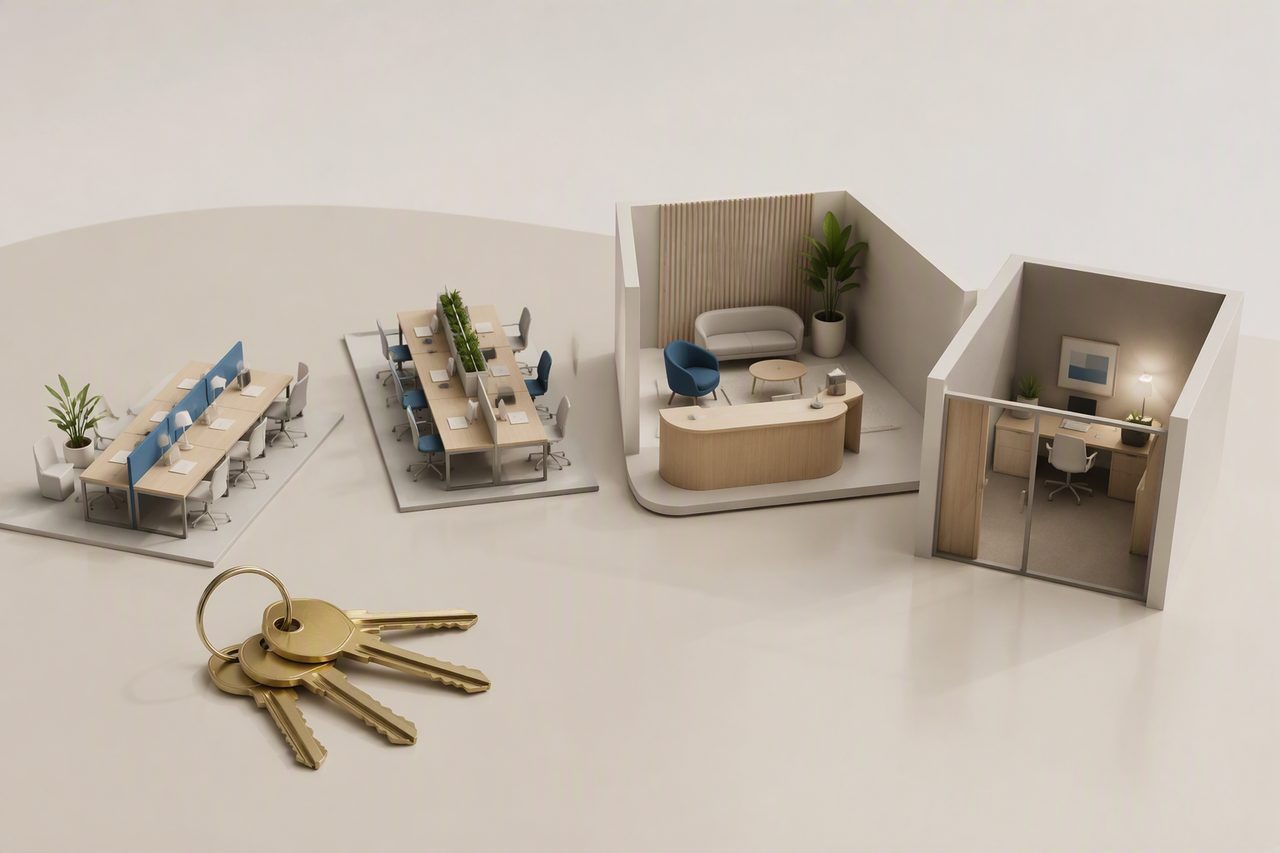
Use Four Questions to Make an Initial Choice
1. How will your first team work?
Start by listing your initial roles rather than deciding on office size first. Sales, customer support, development, finance, management and recruitment roles can have very different needs for quiet working conditions, meeting frequency, equipment and visitor management.
If most employees work remotely and attend the office occasionally, coworking may be a better match. If stable cross-functional collaboration is needed, a serviced office is often easier to manage. If the team needs to work together frequently in the same location over the longer term, a private office may be worth assessing.
2. Does your business involve confidentiality, client visits or specific equipment needs?
Teams handling client information, financial documents, source code, recruitment interviews or sensitive commercial discussions should prioritise privacy and access management before rent. Businesses receiving clients should also inspect the lobby, reception, meeting rooms and visitor process in person to determine whether they fit the company's brand and way of working.
Do not assume that an office with internet automatically meets your business requirements. Based on your business activity description, define the required level of internet reliability, backup connectivity, equipment connection methods, data-use rules and fault-reporting process. For further guidance on office location, connectivity, power and business continuity considerations in Colombo, refer to the published Colombo Office Location and Infrastructure Guide: Business Parks, Internet, Power and Business Continuity.
3. How uncertain is your staffing plan?
Office selection should match your recruitment timeline. If initial employees have not all joined, or the number of roles may change, committing to a long-term space too early may reduce flexibility. If headcount is confirmed and the recruitment pipeline is stable, frequent office changes may also disrupt employee experience and operating arrangements.
It can be useful to consider three scenarios: maintaining current headcount, modest growth and rapid growth. For each scenario, ask whether the space can add desks, change rooms, increase storage or provide additional meeting resources, and what process would apply to make those changes. The purpose is not to predict growth precisely, but to confirm that practical options exist if change occurs.
4. Who will manage day-to-day office operations?
Coworking spaces and serviced offices can usually reduce a company's direct involvement in property-related matters. A private office provides greater control, but the business will need to appoint an internal owner or external coordinator to handle more operational tasks.
If headquarters does not have a dedicated person responsible for local administration, a serviced office may be a practical transitional option. If the company already has administrative, operational or facilities-management capacity and clear space requirements, a private office can offer more room for customisation. MMD Business Support can provide local support with needs assessment, matching available premises, site-visit communication and progress coordination. Lease documentation, legal advice and other matters requiring professional qualifications should be handled by appropriately appointed professional advisers.

Do Not Treat an Office Address as Proof That You Are Ready to Operate
Having an office address does not necessarily mean that a team has all the conditions needed to begin operating. Actual launch readiness may also depend on entity setup progress, assessment of licences relevant to the planned business activities, staffing arrangements, equipment readiness, banking and payment arrangements, and whether the premises can support the way your team needs to work.
For this reason, maintain a project dependency list while reviewing offices. Identify which matters depend on having an office address, which must be completed before employees begin work, and which issues must be confirmed in writing by the building, operator or professional adviser before signing. This can help avoid discovering after incorporation that the office, staffing and business conditions do not align.
For business conditions that should be reviewed before signing an office lease, refer to the published Business Conditions to Confirm Before Signing an Office Lease: Avoid Being Unable to Start Operations After Incorporation. This article focuses on selecting an office model. Allocation of responsibilities, fee items and exit arrangements in a lease should be reviewed against the specific documents before signing.
A Simple Selection Framework
| Your priority | Office model worth prioritising | Key points to confirm during a visit |
|---|---|---|
| Fast start, small team, irregular office use | Coworking space | Desk availability, meeting rooms, visitor arrangements and noise levels |
| Private room with basic operational support | Serviced office | Room privacy, service scope, expansion options, internet and meeting resources |
| Stable team with defined space and management needs | Private office | Handover condition, building capability, fit-out management and long-term operational responsibilities |
The final choice does not need to deliver every aspect of your future office setup from day one. For many companies entering a new market, choosing a space that fits the current team and business stage, then adjusting as recruitment, clients and operations develop, is often easier to execute than pursuing the most complete office from the outset. The objective is to make the office arrangement support your launch plan, rather than allowing the lease to constrain business operations.
This content is provided for general information only and does not constitute legal, tax or immigration advice. Specific requirements should be confirmed with the relevant Sri Lankan authorities and appropriately engaged licensed professionals.
FAQ
- Should a company rent a private office immediately when entering Sri Lanka?
- Not necessarily. Consider the size of the initial team, certainty of employee start dates, client-facing needs, confidentiality requirements and internal administrative capacity. If the staffing plan is still changing, a more flexible space arrangement may make it easier to manage uncertainty during the launch stage before adjusting based on actual operations.
- Can a serviced office be used as a company registered address?
- This should be confirmed case by case based on your proposed entity arrangement, the documents available from the serviced office operator and relevant authority requirements. Do not rely only on verbal sales statements. Before signing, confirm the permitted use of the address, available supporting documents and arrangements for receiving correspondence.
- Is a coworking space suitable for recruitment and interviews?
- It can be, provided the space has reservable meeting areas with sufficient privacy and the candidate reception process meets your recruitment experience requirements. If you conduct interviews frequently or handle sensitive candidate information, a serviced office or private office may be easier to arrange.
- What should I ask about besides rent when viewing an office?
- Key questions include usable areas and facilities, internet and equipment conditions, meeting room and visitor rules, service boundaries, options for increasing headcount, handover condition, the day-to-day contact person, and lease provisions relating to responsibilities, fees and exit arrangements. Lease-related legal responsibilities should be reviewed by an appropriate professional adviser.
Related reading



Need this applied to your case?
Tell us your team size, industry and timeline — we will map the actual path for your project.
Contact us