Company Registration
Sri Lanka Pharma Import and Operating Approval Paths
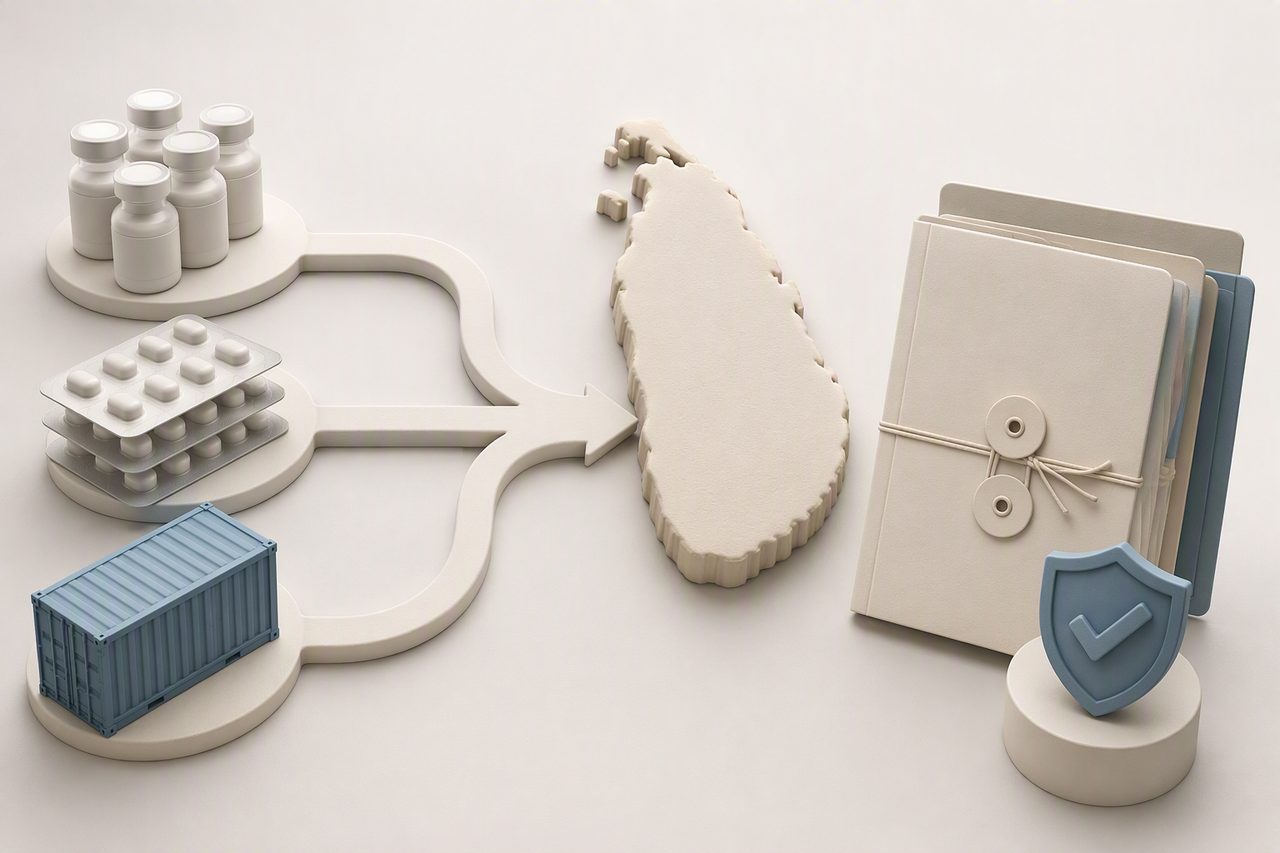
Businesses planning to import, distribute or locally manufacture pharmaceutical products in Sri Lanka should not treat “pharmaceutical approval” as a single workstream. A more reliable approach is to separate the project into product, import, operating activity, premises and responsible-party paths, then identify the relevant requirements, document owners and dependencies for each.
For foreign businesses, rework is often caused not by missing documents, but by leasing warehouse space, signing distribution arrangements or planning an initial shipment before confirming whether the product classification, importer structure or operating model matches the intended plan. The framework below can support internal project preparation and provide a basis for discussions with relevant authorities, licensed professional firms and local partners.
Break the project into five questions
Bringing pharmaceutical products to market commonly involves several connected but distinct issues. Businesses should avoid allowing one department to make decisions for the entire project.
| Path | Core question | Teams that should provide input |
|---|---|---|
| Product path | What regulatory category applies to each product, and are product-level registration, review or other market-entry arrangements required? | Product, regulatory and quality teams |
| Import path | Who will be responsible for importing the goods, how will they enter Sri Lanka, and how will import documents correspond with product documentation? | Supply chain, trade and quality teams |
| Operating path | Will the business conduct wholesale, distribution, promotion, storage, manufacturing or other activities? | Management and commercial teams |
| Premises path | Are the office, warehouse, temperature-controlled space, manufacturing site or third-party facilities suitable for the planned activities? | Operations, facilities and quality teams |
| Responsible-party path | What responsibilities will be held by the overseas headquarters, local company, distributor, importer and service providers? | Legal, finance and project leads |
These five paths can be prepared in parallel. However, businesses should avoid making irreversible commitments before the basic classification work is complete, such as entering into long-term leases, granting exclusive distribution rights, scheduling initial imports or finalising packaging.

Step one: do not assume every product follows the same path
The first task is to build a product list, rather than providing only a brand name or catalogue. The following information should ideally be listed separately for each SKU:
- Generic name, brand name and dosage form;
- Main ingredients, strength, packaging format and intended use;
- Manufacturing location, manufacturer details and available quality documentation;
- Whether the product has been registered, sold or distributed in other markets;
- Existing language versions of labels, package inserts, outer packaging and promotional materials;
- Intended import format, such as finished goods, bulk products, samples or manufacturing materials; and
- Who is intended to hold, promote, store and sell the product in Sri Lanka.
Product classification is the starting point for subsequent work. Terms such as “health”, “medical”, “nutrition” or “treatment” in a product name or marketing description do not automatically determine the regulatory path. Different products within the same group should not be assumed to follow the same arrangement merely because they share a brand. For each product category, businesses should confirm with the relevant authorities and appointed professional firms the applicable product-entry, documentation, labelling and ongoing maintenance requirements.
Product documentation should not be prepared by sales teams alone
Sales materials may explain market positioning, but they are usually not sufficient to determine the appropriate product path. Quality, regulatory, supply chain and commercial teams should review document sources and versions together at an early stage. Particular attention should be given to consistency across product specifications, manufacturing information, authorisation documents, label text and promotional statements. If different documents describe the product’s intended use or responsible party differently, later communications may require repeated clarification.
Step two: separate product market entry from import responsibility
Even while product-level preparation is progressing, the import arrangement should be confirmed separately. At a minimum, the import path should answer the following questions:
- Who will be the responsible party for importing the goods, customs clearance and retaining local records?
- Does the importing entity match the entities named in product-related documents, commercial contracts and payment arrangements?
- Are the authorisation boundaries between the overseas manufacturer, brand owner, local company and distributor documented in writing?
- Will the initial shipment be a commercial import, samples, display items or goods for another purpose?
- Who will retain and reconcile customs documents, shipping documents, batch documentation and commercial invoices?
- If a third-party importer or distributor is used, how will the parties allocate responsibilities for inventory, returns, recall coordination and complaint forwarding?
The importing entity should not be selected solely for operational convenience. Businesses should also assess whether that entity can continuously manage documentation, batch traceability, regulatory communications and supply chain coordination. If the overseas headquarters plans to establish a local company later, it should also identify in advance the items that may need to be reviewed again when moving from a transitional import arrangement to a longer-term operating model.
For a general approach to preparing for import, storage and distribution activities, businesses may also refer to the published article, “How Cross-Border Trading Businesses Can Review Import, Storage and Distribution Requirements Before Establishing a Local Company.” Pharmaceutical projects should nevertheless be guided by the confirmation outcome for the specific products and planned activities.

Step three: create an activity map based on actual operations
“Selling pharmaceutical products in Sri Lanka” may involve a range of different activities. Project teams should break the commercial plan into identifiable actions rather than relying only on broad terms such as “trading” or “distribution” in incorporation documents or business plans.
At a minimum, consider each of the following:
- Will the business only conduct market research, customer visits or brand promotion?
- Will it sign local distribution, agency or supply agreements?
- Will a local entity issue invoices, receive payments or hold inventory in its own name?
- Will it store, transport, repackage, relabel or manage returns itself?
- Will it employ sales, medical, quality, warehouse or pharmacy-related personnel?
- Will it conduct local manufacturing, packaging, testing or contract manufacturing?
- Will it supply healthcare institutions, retail outlets, distributors or consumers directly?
Each additional activity may change the entity qualifications, premises conditions, document responsibilities and scope of specialist support that need to be considered. Company establishment, product preparation, import arrangements and commercial contracts should therefore not be progressed in complete isolation. For a general overview of entity selection, businesses may refer to “Foreign Businesses Entering Sri Lanka: Choose a Subsidiary, Branch or Representative Office Based on Your Activities First.”
Step four: include premises and quality-management arrangements early in the project plan
For pharmaceutical projects, premises are not simply a question of whether the business has an office. Based on its actual activities, the business should determine whether it will use its own facilities, a third-party warehouse, a distributor’s warehouse, a manufacturing site or other outsourced facilities. It should also review whether those arrangements can support the planned storage, delivery, record-retention and quality-management work.
Before signing a lease, warehousing agreement or third-party logistics agreement, it is advisable to prepare a premises checklist covering:
- The specific activities the premises are expected to support;
- Which party is responsible for daily operations, inbound and outbound records, and exception handling;
- Whether the products require particular storage or transport conditions;
- Who maintains inventory, batch, expiry-date and return records;
- How the notification process will begin in the event of a quality complaint, damage, temperature-control deviation or recall coordination; and
- Whether the premises agreement and service agreement align with the allocation of product responsibilities.
Businesses should not determine premises suitability solely on the basis of property descriptions, verbal statements from logistics providers or experience in other industries. They should confirm the requirements for the intended activities with the relevant authorities, appointed professional firms and facility operators, and incorporate the outcome into site-selection and contract-approval processes.
Step five: use a responsibility matrix to connect headquarters, local entities and partners
Pharmaceutical projects often involve overseas manufacturers, brand owners, local companies, importers, distributors, warehouse operators and professional firms. A responsibility matrix should be established early in the project to identify, at a minimum, the owner, reviewer and document custodian for the following matters:
| Workstream | Responsibility questions to clarify |
|---|---|
| Product documentation | Who provides source materials, and who confirms consistency between versions and translations? |
| Product-path communications | Who is responsible for submissions, supplemental materials and retaining correspondence records? |
| Import-document coordination | Who checks commercial documents, shipping documents and product information? |
| Storage and inventory | Who maintains batch, expiry, receipt, dispatch and exception records? |
| Marketing materials | Who reviews promotional materials and product statements before use? |
| Quality-event coordination | Who receives complaints, and who notifies headquarters and relevant partners? |
| Contracts and payments | Who signs contracts, and who is responsible for payments, tax matters and document filing? |
The value of a responsibility matrix is not that it replaces professional advice. It helps prevent gaps where headquarters assumes that the local distributor is responsible, while the local distributor assumes that the manufacturer is responsible.
Suggested preparation sequence
For projects that have not yet started, internal work can be arranged in the following order:
- Compile a complete list of products and planned business activities;
- Define the target commercial model and the roles of local partners;
- Obtain professional confirmation on product classification, product path and import arrangements;
- Assess the company structure, contract framework and fund flows in parallel;
- Select premises, warehousing and operating resources based on the confirmed activity scope;
- Establish a document checklist, responsibility matrix and version-control process; and
- Before the initial shipment, commercial promotion or formal sales begin, review whether each arrangement still matches the actual operating plan.
MMD Business Support can assist businesses in clarifying requirements, coordinating document checklists, matching local resources and facilitating communications with appropriately qualified company registration, legal, tax, audit, immigration and industry professional firms during project implementation. Specific requirements relating to product entry, import, operating activities, premises and contracts should be confirmed based on the latest guidance from Sri Lankan authorities and appointed licensed professional firms.
This content is provided for general information only and does not constitute legal, tax or immigration advice. Specific requirements should be confirmed based on the latest guidance from Sri Lankan authorities and appointed licensed professional firms.
FAQ
- We already hold product registration in another country. Can we import and sell directly in Sri Lanka?
- A decision should not be made based only on overseas registration status. The business should still confirm the classification of the specific product in Sri Lanka, product-level preparation, importer arrangements, labelling documentation and local operating requirements. Overseas materials may form part of the preparation package, but should not be treated as a conclusion on local market entry.
- Can we use a local distributor as the importer first and establish our own company later?
- This may be assessed as one possible commercial model, but the allocation of responsibilities during the transitional period and after the later change should be defined first. In particular, businesses should review who holds product-related documents, import records, inventory records, authorisations, contractual rights, customer information and complaint information, and confirm whether any matters need to be reapplied for or updated when the arrangement changes.
- Must we establish a local company before starting to prepare product documentation?
- Product-document preparation, commercial-model design and preliminary path discussions can begin first. However, the party that submits, holds, imports, stores and sells the products should be consistent with the final responsible-party arrangement. Businesses may prepare the entity structure and product documentation in parallel to avoid reorganising documents after the entity has been confirmed.
- If we outsource warehousing and distribution to a third party, do we still need to consider premises issues?
- Yes. Even where the business does not operate its own warehouse, it should still confirm the actual activities performed by the third-party facility, the service scope, record retention, exception handling, inventory responsibilities and contractual boundaries. Whether the arrangement is suitable and how relevant requirements are to be met should be confirmed item by item with the relevant authorities, appointed professional firms and facility operator.
Related reading



Need this applied to your case?
Tell us your team size, industry and timeline — we will map the actual path for your project.
Contact us