Customs
How to Assess Telecom Equipment Clearance Before Importing Routers and Wireless Devices into Sri Lanka

Before importing routers and wireless devices into Sri Lanka, do not rely on the product name alone to decide whether telecom equipment clearance or release confirmation may be needed. Confirm the device’s communication functions, model and intended use, then align regulatory checks, import declarations, shipping documents and project delivery plans before shipment.
You may already have a supplier quotation and a shipment ready to move, only to find that the purchase list says little more than “router”, “access point” or “wireless device”. The issue is usually not whether the equipment can be purchased. It is whether someone has confirmed its technical characteristics, whether the importer holds the right documents, whether model details will match at clearance, and whether the site can absorb a delivery delay. For IT integrators and project procurement teams, this work belongs before the purchase order is placed.
Do routers need telecom equipment clearance if they are not mobile phones?
A common assumption: Only mobile phones, two-way radios or large communications systems may fall within communications equipment controls. Standard office routers, enterprise Wi-Fi access points and wireless bridges can simply be imported as ordinary IT hardware.
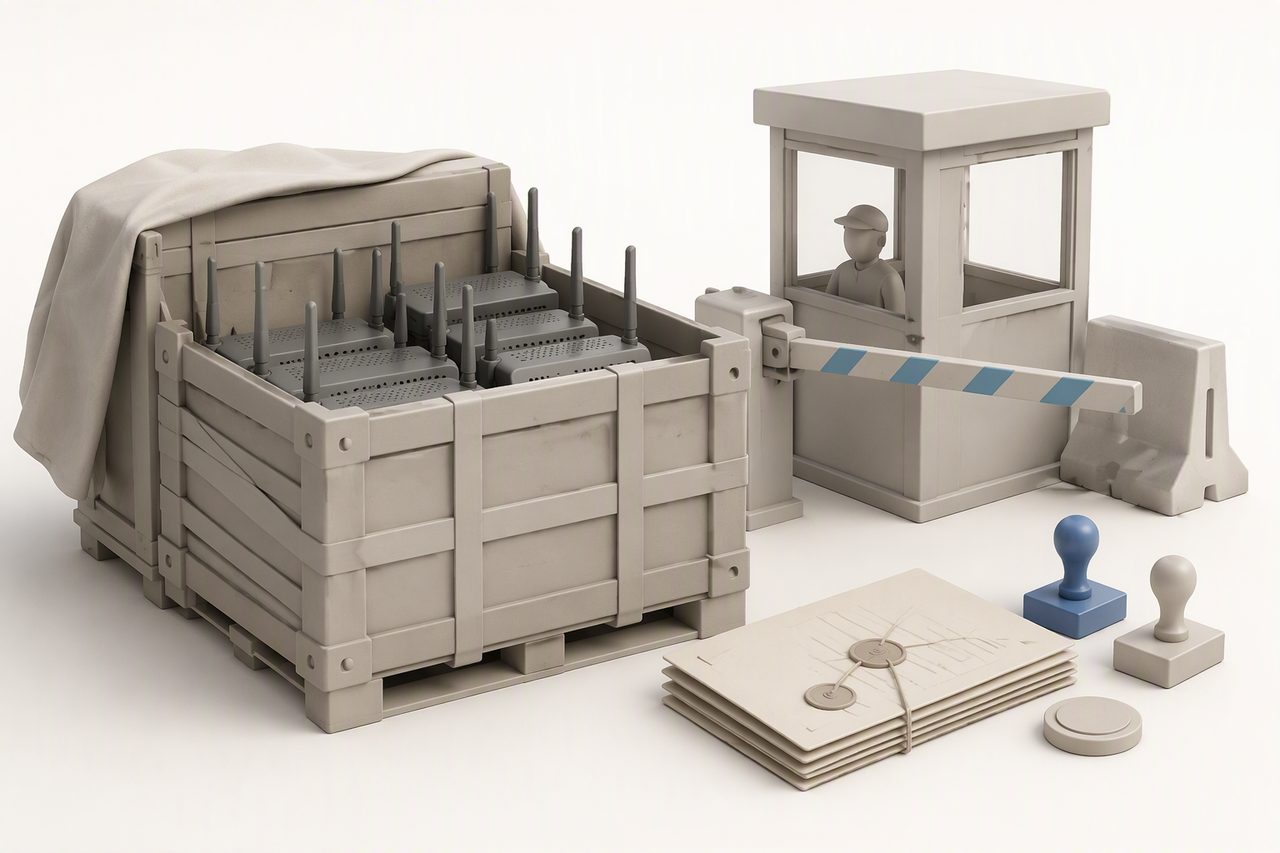
In practice: A device name does not replace an assessment of its characteristics. You need to consider whether it has wireless transmission or reception capabilities, cellular connectivity, satellite connectivity or other communications interfaces. It also matters whether the item is sold as a standalone device, imported as a system component, or delivered together with other project equipment. Different items on the same purchase order may need to be checked separately.
Supplier datasheets are a starting point, not a complete answer. Before placing an order, ask the supplier for model numbers, product datasheets, technical specifications, a description of wireless functions, frequency-band or communications-module information, country-of-origin details and draft commercial invoice information. If the product has several hardware or regional versions, a product family name alone is not enough.
The cost of getting this wrong: If the documentation proves insufficient only after the shipment arrives, the importer may need to provide additional technical documents, reconfirm the model or revise declaration documents. Where installation personnel, data-centre access windows or customer acceptance have already been scheduled, the delivery plan can be disrupted as well.
Does “exportable” from the supplier mean it can clear customs in Sri Lanka?
A common assumption: An overseas supplier that regularly exports routers and wireless equipment can confirm that a product is exportable, so there should be no additional issue with importing or clearing it in Sri Lanka.
In practice: A supplier’s comments on export-country rules, product certification or transport restrictions do not replace local regulatory and customs confirmation in Sri Lanka. The importing party should check the required documents and sequence of steps with the relevant communications regulator and the customs declaration service provider, based on the actual importer, product model, quantity, intended use and shipping arrangement.
Make the questions specific. Ask whether the model requires equipment-related confirmation before shipment; who should apply for or hold the confirmation document; how the equipment should be described in the import declaration; and whether samples, project test units, bulk shipments and after-sales replacement items should be handled under the same approach. Asking only “Do we need a licence?” often does not produce a usable document checklist.
The cost of getting this wrong: The purchase contract, shipping documents and customs declaration may describe the goods differently. Even where the equipment itself has not changed, inconsistencies in product name, model, quantity or intended use can make subsequent discussions more difficult.

Can telecom equipment checks wait until the shipment reaches the port?
A common assumption: Ship the equipment first, then let the freight forwarder, customs broker or local colleague deal with the matter after arrival because customs clearance already requires documents.
In practice: Checks for wireless equipment should run alongside procurement and shipping planning, not begin after arrival. Before shipment, you should at least establish who the importer is, how the commercial invoice and packing list will describe the goods, who holds the technical documents, whether any confirmation must be obtained in advance, and who can communicate on the importer’s behalf if additional documents are requested.
There is another frequent gap. The project procurement team holds the technical specifications, finance holds payment documents, the freight forwarder manages transport milestones, and the importer holds corporate documents. Yet nobody maintains a consolidated model list and record of regulatory communications. The gap becomes more visible where there are many devices, multiple brands or phased deliveries.
The cost of getting this wrong: Arrival-related costs are not limited to a government charge. They may include freight-forwarding services, document corrections, storage, container or port detention, rerouting, and the cost of rescheduling installation personnel. Amounts vary by transport method, port arrangements, length of stay, equipment type and service scope. Obtain written quotations, including exclusions, separately from logistics providers, customs service providers and appointed professional advisers.
Does clearance confirmation mean the delivery risk has ended?
A common assumption: Once regulatory confirmation and customs documents are in place, the equipment can be delivered to the customer site and the procurement team’s work is complete.
In practice: Equipment release, on-site installation and final handover are separate milestones. For enterprise network projects, serial numbers, models, quantities, configuration versions and the project delivery list should be capable of being matched against one another. If the imported items are system components, also confirm whether the site has the required power adapters, rack space, network access, installation window and acceptance owner.
Do not leave equipment confirmation records only in an individual’s email inbox. Maintain a project folder containing supplier specifications, confirmation records, invoices, packing lists, transport documents, declaration documents and proof of receipt. These records are more useful than verbal explanations if there is an after-sales replacement, a repeat purchase of the same model or a customer audit.
The cost of getting this wrong: The equipment may have entered the country but still be unavailable for planned use because the model does not match, accessories are missing, site conditions are not ready or responsibilities are unclear. Completing the purchase does not mean the project is complete.
How can you create a pre-order checklist for wireless equipment?
| Review question | Documents to prepare | Who to check with | Record to retain |
|---|---|---|---|
| Does the equipment include wireless, cellular, satellite or other communications functions? | Model list, datasheets, product manuals | Supplier and relevant communications regulator | Written technical description and confirmation record |
| Are you importing complete devices, modules, accessories or system components? | Purchase list, bill of materials, intended-use description | Project lead, supplier and customs declaration service provider | Model-by-model goods list |
| Who is the importer, and who handles declarations and document signing? | Corporate documents, authorisation arrangements, purchase contract | Importer and customs declaration service provider | Responsibility matrix |
| Do the model details in the invoice, packing list and technical documents match? | Draft invoice, draft packing list, specifications | Supplier, procurement team and customs declaration service provider | Final document pack |
| Will there be phased shipments, samples, replacement parts or after-sales repairs? | Shipping plan, after-sales terms | Logistics provider, project team and relevant regulator | Corresponding documents for each shipment |
| Who coordinates installation and acceptance after arrival? | Delivery plan, site-readiness checklist | Customer project lead and installation team | Arrival and receipt records |
Customs declarations and import arrangements in Sri Lanka should follow the latest requirements published by Sri Lanka Customs. For communications equipment characteristics and any potentially applicable regulatory confirmation, obtain written guidance corresponding to the specific model, intended use and import arrangement from the relevant communications regulator and appointed professional advisers.
If your project is still deciding Incoterms and transport responsibilities, you may also wish to read the published guide, How to Choose Incoterms for Your First Import into Sri Lanka and Avoid Misaligned Taxes and Responsibilities. For wireless equipment projects, Incoterms affect more than freight allocation: they can also affect who controls shipping documents and who carries the coordination pressure after arrival.
This content is for general information only and does not constitute legal, tax or immigration advice. Specific requirements should be confirmed against the latest guidance from Sri Lankan authorities and appointed licensed professional advisers.
FAQ
- Do standard enterprise Wi-Fi routers need telecom equipment checks before they are imported into Sri Lanka?
- It is advisable to check. Whether approval, clearance or release arrangements may be required cannot be determined from the term “enterprise Wi-Fi router” alone. Provide the specific model, wireless functions, technical specifications, intended use and import arrangement to the relevant communications regulator and customs declaration service provider for confirmation.
- The supplier has CE, FCC or other overseas certifications. Do we still need to check requirements in Sri Lanka?
- Overseas certification documents can help explain a product’s technical characteristics, but they do not usually replace Sri Lankan confirmation for import and communications equipment regulatory purposes. Before ordering, check whether these documents are sufficient to support the locally required documentation.
- In what order should wireless equipment confirmation, customs declarations and clearance be arranged?
- The usual approach is to confirm the device characteristics and document requirements before preparing shipping documents and the import declaration. This reduces the risk of having to provide technical documents only after the shipment arrives. The exact sequence should be confirmed based on the model, importer, transport method and the latest requirements of the relevant authorities.
- Which costs should be questioned in a quotation for importing wireless equipment?
- Ask separately about services related to regulatory confirmation, customs declaration, transport, storage, document correction and possible on-site coordination. Request that each provider explain what is included, excluded, subject to assumptions and charged additionally if delays occur. Do not compare quotations on total price alone.
Related reading


Need this applied to your case?
Tell us your team size, industry and timeline — we will map the actual path for your project.
Contact us